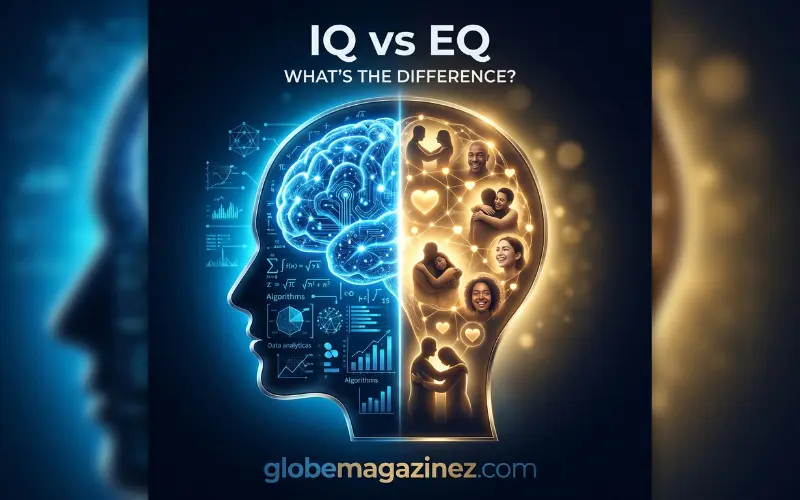
For decades, IQ has been one of the most talked-about measures of intelligence. Schools, employers, and researchers have used IQ tests to evaluate reasoning, problem-solving, and learning abilities. Because of this, many people assume that a high IQ is the key to success.
However, there is another form of intelligence that has gained significant attention in recent years: EQ, or Emotional Intelligence. While IQ focuses on cognitive abilities, EQ focuses on understanding emotions, managing relationships, and making effective social decisions.
So, which one matters more? Is a high IQ enough to succeed in life, or can emotional intelligence be even more important?
In this guide, you’ll learn the difference between IQ and EQ, how they work, their strengths and limitations, and why both play an important role in personal and professional success.
What Is IQ?
IQ stands for Intelligence Quotient. It is a score derived from standardized tests designed to measure specific cognitive abilities.
IQ tests typically evaluate:
- Logical reasoning
- Problem-solving skills
- Mathematical thinking
- Pattern recognition
- Memory
- Verbal comprehension
- Analytical abilities
The average IQ score is set at 100, with most people scoring within a similar range.
IQ has long been used in educational settings, research studies, and psychological assessments because it provides a structured way to measure certain aspects of intelligence.
A person with a high IQ often learns quickly, solves complex problems efficiently, and performs well in tasks that require analytical thinking.
However, IQ does not measure every type of intelligence. Skills such as empathy, leadership, communication, and emotional awareness are largely outside the scope of traditional IQ testing.
Why IQ Became So Popular
IQ testing became popular in the early twentieth century when psychologists sought a scientific method to evaluate cognitive abilities.
Educational institutions used IQ tests to identify students who needed additional support or advanced academic opportunities. Over time, governments, military organizations, and researchers also adopted IQ assessments.
Several factors contributed to the popularity of IQ:
Standardized Measurement
IQ tests provide consistent scoring methods, making it easier to compare results across large populations.
Educational Applications
Schools often use cognitive assessments to better understand student learning needs.
Research Benefits
IQ testing has helped researchers study intelligence, learning, memory, and human development.
Predictive Value
Studies have shown that IQ can correlate with certain academic and professional outcomes, particularly in fields requiring strong analytical skills.
Because of these advantages, IQ became one of the most widely recognized measures of intelligence worldwide.
What Is EQ?
EQ stands for Emotional Quotient, often referred to as Emotional Intelligence.
Unlike IQ, which focuses on cognitive skills, EQ measures how effectively a person understands and manages emotions.
Emotional intelligence includes several key abilities:
- Self-awareness
- Emotional regulation
- Empathy
- Social skills
- Relationship management
- Motivation
- Communication
A person with high EQ can often remain calm under pressure, understand the emotions of others, resolve conflicts effectively, and build strong personal and professional relationships.
Emotional intelligence is not measured by traditional IQ tests. Instead, it is usually assessed through behavioral evaluations, questionnaires, and observation of interpersonal skills.
In today’s workplace and social environments, EQ is increasingly recognized as a critical factor in leadership and long-term success.
Why Emotional Intelligence Became Important
As workplaces evolved, researchers discovered that technical skills and cognitive ability alone did not fully explain why some people excelled while others struggled.
Many successful individuals demonstrated exceptional emotional intelligence even if they were not considered intellectual geniuses.
Several factors contributed to the growing importance of EQ.
Better Workplace Relationships
Employees with strong emotional intelligence often collaborate more effectively with colleagues.
Improved Leadership
Leaders with high EQ tend to inspire trust, motivate teams, and handle difficult situations more effectively.
Conflict Resolution
Emotional intelligence helps people manage disagreements without damaging relationships.
Mental Well-Being
Individuals with higher emotional awareness are often better equipped to cope with stress and setbacks.
These advantages have made EQ an increasingly valuable skill in both personal and professional life.
Key Features of IQ
Understanding the characteristics of IQ helps explain its role in human performance.
Logical Thinking
IQ tests often measure the ability to analyze information and identify patterns.
Problem-Solving Ability
Individuals with higher IQ scores generally perform well when solving complex problems.
Learning Speed
High-IQ individuals often learn new concepts quickly.
Analytical Reasoning
IQ is strongly linked to critical thinking and logical analysis.
Memory Performance
Many cognitive assessments include memory-related tasks.
These abilities can be highly beneficial in academic, scientific, and technical fields.
Key Features of EQ
Emotional intelligence focuses on a different set of skills.
Self-Awareness
Understanding your own emotions and reactions.
Self-Control
Managing emotions effectively during challenging situations.
Empathy
Recognizing and understanding the feelings of others.
Communication
Expressing thoughts clearly while listening effectively.
Relationship Building
Creating and maintaining healthy personal and professional relationships.
These skills play a major role in teamwork, leadership, and social success.
IQ vs EQ: The Main Differences
Although both forms of intelligence are valuable, they focus on very different abilities.
| IQ | EQ |
| Measures cognitive intelligence | Measures emotional intelligence |
| Focuses on logic and reasoning | Focuses on emotions and relationships |
| Evaluated through standardized tests | Assessed through behavior and emotional skills |
| Important for academic performance | Important for social and professional success |
| Helps solve technical problems | Helps manage people and emotions |
| Often linked to analytical careers | Often linked to leadership roles |
The most successful individuals often develop both IQ and EQ rather than relying on one alone.
Use Cases of IQ and EQ
In Education
IQ can help identify learning strengths and cognitive abilities.
EQ helps students develop communication skills, emotional resilience, and teamwork.
In the Workplace
IQ is often valuable for technical jobs requiring analysis and problem-solving.
EQ helps employees collaborate, communicate, and manage workplace relationships.
In Leadership
Leaders benefit from strong cognitive abilities, but emotional intelligence often determines how effectively they manage teams.
In Personal Relationships
EQ plays a larger role in understanding others, resolving conflicts, and maintaining healthy relationships.
In Decision-Making
IQ helps analyze facts and information.
EQ helps consider emotional and social consequences.
Can You Have High IQ and Low EQ?
Yes.
Some individuals possess exceptional analytical abilities but struggle with communication, empathy, or emotional regulation.
For example, a person may excel at solving technical problems but find it difficult to work effectively within a team.
Similarly, someone may have average cognitive abilities but outstanding emotional intelligence, allowing them to become an excellent leader, manager, or communicator.
This is one reason why IQ alone cannot predict overall success in life.
Which Is More Important: IQ or EQ?
This is one of the most common questions people ask.
The answer depends on the situation.
If you are solving mathematical equations, designing software, or conducting scientific research, IQ may play a larger role.
If you are managing teams, building relationships, negotiating, or leading organizations, EQ often becomes more important.
In reality, both are valuable.
Many experts believe long-term success is influenced by a combination of:
- Cognitive intelligence
- Emotional intelligence
- Communication skills
- Discipline
- Adaptability
- Experience
Focusing on only one area may limit personal and professional growth.
Pros and Cons of IQ
Pros
- Measures analytical abilities
- Useful for educational assessment
- Helps identify cognitive strengths
- Standardized scoring system
- Valuable for research
Cons
- Does not measure emotional intelligence
- Cannot predict success accurately
- May overlook creativity
- Influenced by testing conditions
- Represents only one aspect of intelligence
Pros and Cons of EQ
Pros
- Improves relationships
- Supports leadership development
- Helps manage stress
- Encourages empathy
- Strengthens teamwork
Cons
- Difficult to measure accurately
- Assessment methods vary
- Can be influenced by self-reporting bias
- Less standardized than IQ testing
Common Mistakes People Make
Believing IQ Is Everything
Many people assume a high IQ guarantees success. In reality, emotional skills, work ethic, and adaptability are equally important.
Ignoring Emotional Intelligence
Some individuals focus entirely on academic achievement while neglecting communication and relationship-building skills.
Treating IQ and EQ as Competitors
IQ and EQ are not opposing forces. They complement each other.
Assuming EQ Cannot Be Improved
Unlike some cognitive abilities, emotional intelligence can often be developed through practice and self-awareness.
Judging People Based on One Score
No single test can fully capture a person’s potential, talents, or character.
Alternatives and Related Concepts
Several other concepts help explain human abilities beyond IQ and EQ.
Social Intelligence
The ability to navigate social situations effectively.
Practical Intelligence
Applying knowledge to real-world challenges.
Creative Intelligence
Generating innovative ideas and solutions.
Adaptability
Adjusting successfully to changing environments and circumstances.
These abilities often work together with IQ and EQ to shape overall success.
📚 Related Articles You May Like
Average IQ by Age Explained Simply How Online Reviews Impact Trust and Decisions What Is PushWiki and How Knowledge Platforms Work Modern Thinking Skills in the Digital Age How Online Games Affect Thinking and BehaviorFAQs
What is the difference between IQ and EQ?
IQ measures cognitive abilities such as reasoning and problem-solving, while EQ measures emotional awareness and interpersonal skills.
Which is more important, IQ or EQ?
Both are important, but EQ often plays a major role in leadership, relationships, and workplace success.
Can a person have high IQ and low EQ?
Yes. Strong analytical skills do not automatically mean strong emotional intelligence.
Can emotional intelligence be improved?
Yes. Self-awareness, empathy, communication, and emotional regulation can be developed over time.
Does IQ determine success?
No. Success depends on many factors including EQ, discipline, motivation, and experience.
What is considered a high IQ?
An IQ score above 120 is generally considered above average or high.
Is EQ measured with a test?
EQ can be assessed through questionnaires, evaluations, and behavioral observations.
Do employers value EQ?
Yes. Many employers consider emotional intelligence important for teamwork and leadership.
Can someone have average IQ and high EQ?
Absolutely. Many successful leaders and communicators have average IQ scores but excellent emotional intelligence.
Why are IQ and EQ both important?
Together, they help people think effectively, communicate well, solve problems, and build strong relationships.
Conclusion
The debate between IQ and EQ is not about choosing one over the other. Both forms of intelligence contribute to success in different ways.
IQ helps people think critically, solve problems, and process information efficiently. EQ helps people understand emotions, build relationships, communicate effectively, and lead others.
A high IQ can open doors, but emotional intelligence often determines how well a person navigates opportunities, challenges, and relationships throughout life.
The most successful individuals are usually those who combine strong cognitive abilities with strong emotional skills. Rather than focusing on which is more important, it is better to develop both and use them together to achieve personal and professional growth.